5 DeFi Lending Platforms to Compare in 2026


Ledn has over $10 billion in loan originations since 2018 and counting!
DeFi lending lets you borrow from smart-contract markets using onchain collateral. It can be fast and permissionless, but the borrower assumes responsibilities that a centralised lender may handle: wallet security, network selection, transaction execution and continuous liquidation monitoring.
There is no single “best” DeFi loan. The right market depends on the asset, chain, available liquidity, oracle, rate model and liquidation threshold at the moment you borrow.
Holding native Bitcoin rather than an onchain token? Compare Ledn Bitcoin-backed loans. Ledn is centralised, not DeFi, and eligibility varies.
DeFi lending platforms compared
| Protocol | Network focus | Borrowing design | Distinctive feature |
|---|---|---|---|
| Aave | Ethereum and multiple other networks | Pooled, overcollateralised markets | Broad deployments and health-factor monitoring |
| Morpho | EVM-compatible networks | Permissionless isolated markets | Each market has immutable collateral, loan asset, oracle, rate model and LLTV inputs |
| Compound III | Several EVM networks | Separate base-asset markets | Collateral backs borrowing of the market's base asset |
| Liquity V2 | Ethereum | ETH/LST-backed BOLD borrowing | Borrowers choose and manage their interest rate |
| Kamino | Solana | Lending markets and reserves | Solana-native markets with configurable LTV, thresholds, curves and oracles |
Rates change continuously. Compare the exact market, not a protocol-wide average.
1. Aave: broad, established multi-chain borrowing
Aave allows users to supply supported tokens and borrow available assets through overcollateralised markets. Borrow rates are dynamic, influenced by utilisation and governance parameters. A health factor summarises the position's distance from liquidation.
Aave may fit users who want broad asset and network choice with extensive public documentation. Aave publishes audits and describes layered security work, but it also states that smart-contract risk cannot be eliminated.
Check before borrowing: network, collateral LTV, liquidation threshold, borrow rate mode, oracle, supply/borrow cap and available liquidity.
2. Morpho: permissionless isolated markets
Morpho lets anyone create an overcollateralised ERC-20 lending market. Each market is defined by a collateral asset, loan asset, oracle, interest-rate model and liquidation LTV. The isolation makes market selection central to risk assessment: two Morpho markets can have different parameters and liquidity even if they share one asset.
Morpho may fit advanced users who want granular market choice. Its documentation says a position can be liquidated when LTV meets or exceeds the market's LLTV; a liquidator can repay debt and seize collateral plus an incentive.
Check before borrowing: who created or curates the market, oracle design, LLTV, rate model, liquidity, warnings and whether the tokens themselves introduce peg or issuer risk.
3. Compound III: borrowing a market's base asset
Compound III uses separate markets built around a base asset. Users supply supported collateral and borrow the base asset within the applicable borrowing-capacity rules. Rates respond to base-asset utilisation, with a steeper curve beyond a configured kink.
Compound may fit someone who wants a comparatively legible base-asset market. Collateral supplied to Compound III does not itself earn interest, and a borrow must satisfy the market's minimum size and collateral factors.
Check before borrowing: the specific deployment, base asset, supported collateral, borrow factor, liquidation factor, penalty, supply cap and minimum borrow.
4. Liquity V2: borrower-set rates for BOLD
Liquity V2 lets users borrow the BOLD stablecoin against ETH, wstETH or rETH. Borrowers choose an interest rate rather than accepting a governance- or utilisation-set rate. A lower chosen rate can affect a position's place in protocol redemption mechanics, so it should not be treated as a free choice without consequences.
Liquity's documentation states a minimum debt of 2,000 BOLD and no fixed repayment schedule while the position remains healthy. It relies on third-party or community frontends rather than one official frontend.
Check before borrowing: frontend, collateral market, chosen rate, redemption exposure, liquidation rules, BOLD liquidity and transaction costs.
5. Kamino: Solana-native lending markets
Kamino provides lending and borrowing infrastructure on Solana. Its documentation describes markets with configurable reserves, LTVs, liquidation thresholds, rate curves and oracles.
Kamino may fit users already operating on Solana who want to borrow supported assets without bridging to an EVM network. The protocol, network, oracle and token risks still require evaluation.
Check before borrowing: reserve parameters, oracle, available liquidity, market administrator or curator, Solana wallet security and liquidation threshold.
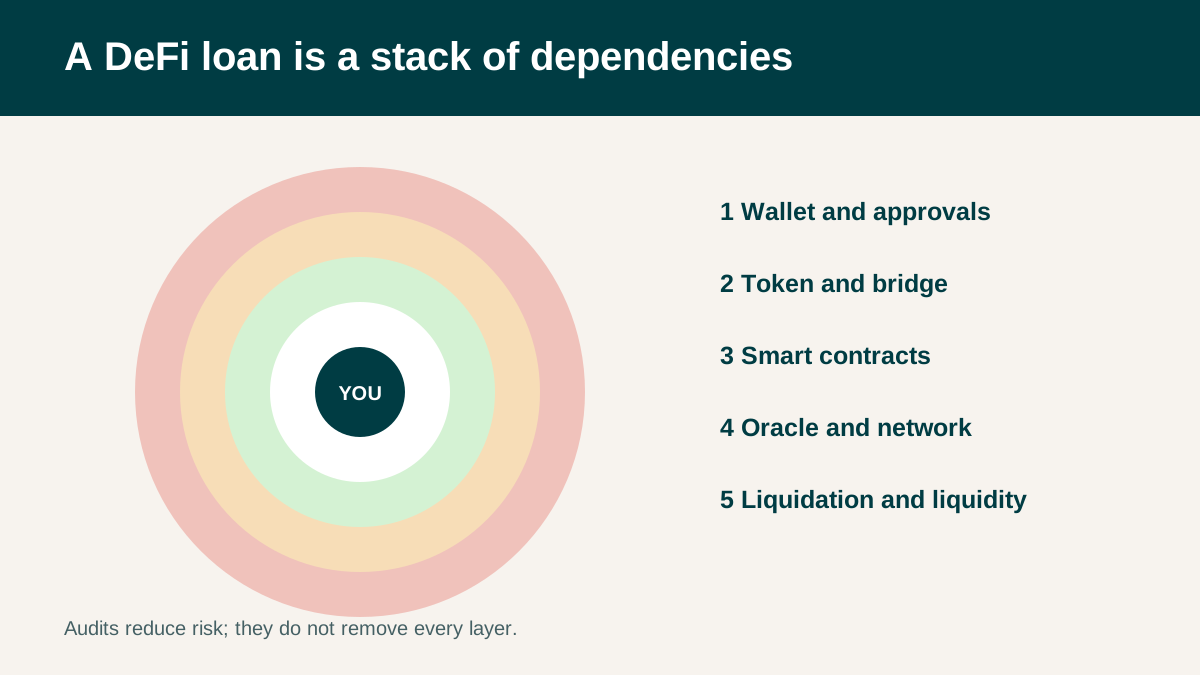
The hidden dependencies in a DeFi loan
The token
If you start with native BTC, using DeFi usually requires tokenised Bitcoin on another network. Your position then depends on the token issuer or bridge maintaining redemption and its peg.
The smart contracts
Audits reduce risk; they do not remove it. A vulnerability may exist in the protocol, integration, frontend, oracle or token.
The oracle and liquidators
The oracle determines collateral value. When a threshold is crossed, bots can liquidate eligible positions. Congestion or transaction failure may prevent you from adding collateral in time.
The loan asset
Borrowing a stablecoin introduces its own issuer, peg and liquidity risk. The dollar value may not remain exactly one dollar in stressed markets.
Your wallet
Lost keys, malicious approvals, phishing and signing the wrong transaction are borrower risks. No support agent can reverse a correctly executed blockchain transaction.
DeFi loan vs a centralised Bitcoin-backed loan
DeFi may suit users who value permissionless access, onchain transparency and market choice. A centralised lender may suit users who want native BTC collateral, fiat rails, a fixed term, support and a contract with an operating entity. For one direct example, compare Ledn vs Aave.
Ledn loans typically open at 50% LTV, have a USD 500 minimum and a 12-month standard term, with published fixed APR of 9.25%–11.49% based on loan size. Ledn sends LTV notifications at 70% and 75% and liquidates at or above 80%. That structure is not “better DeFi”; it is a different risk arrangement.
Frequently asked questions
What is DeFi lending?
It is onchain borrowing and lending governed largely by smart contracts. Users supply supported assets and borrow within collateral rules set by a protocol or market.
Which DeFi platform has the lowest rate?
Rates change by asset, network and market. Compare live borrow APY, incentives, transaction costs and liquidation parameters. A temporary reward can make a displayed net rate look lower without reducing the debt's underlying accrual.
Can I get a DeFi loan against Bitcoin?
Usually not against native BTC directly. You generally need a tokenised representation of Bitcoin on a compatible network, which adds dependencies and may have tax consequences.
Can a DeFi loan be liquidated immediately?
Once a position meets a market's liquidation condition, a third party or bot may execute the liquidation. There may be no manual grace period.
Are audited protocols safe?
Audits are useful evidence of review but not a guarantee. Consider contract, oracle, governance, frontend, network, token and liquidity risks together.
Editorial sources
Related Ledn guides: Aave alternatives, Aave vs Compound, crypto lending platforms and Ledn security.
- Aave borrowing guide
- Aave security
- Morpho FAQ
- Morpho LTV and health documentation
- Compound III documentation
- Liquity V2 borrowing and liquidations
- Kamino documentation
- Ledn Bitcoin-backed loans
This article is general information only, not financial, investment, legal, accounting or tax advice. It does not endorse a protocol. DeFi can result in partial or total loss through liquidation, smart-contract failure, token failure, oracle problems, network events or user error. Please read Ledn's Risk Disclosure Statement and Disclaimers.
The experts opinions:

CTA Block 1
Ledn was created by people who believe in Bitcoin’s power to revolutionise finance and build wealth reliably.
CTA ButtonCTA Block 2
Ledn was created by people who believe in Bitcoin’s power to revolutionise finance and build wealth reliably.
CTA ButtonCTA Block 3
Ledn was created by people who believe in Bitcoin’s power to revolutionise finance and build wealth reliably.
CTA ButtonCTA Block 4
Ledn was created by people who believe in Bitcoin’s power to revolutionise finance and build wealth reliably.
CTA Button