Aave vs Compound: Which DeFi Lending Protocol Fits in 2026?


Ledn has over $11 billion in loan originations since 2018 and counting!
Aave and Compound both support overcollateralised onchain borrowing, but their current architectures are not interchangeable. Aave offers broad multi-asset markets across many networks. Compound III organises each deployment around a base asset that supported collateral can borrow.
The better choice depends on the exact chain, collateral, loan asset, live rate and liquidation buffer—not the protocol name alone. Details were checked on 3 September 2026.
Borrowing against native Bitcoin rather than an onchain token? Compare Ledn Bitcoin-backed loans. Ledn is centralised, not DeFi, and product availability varies.
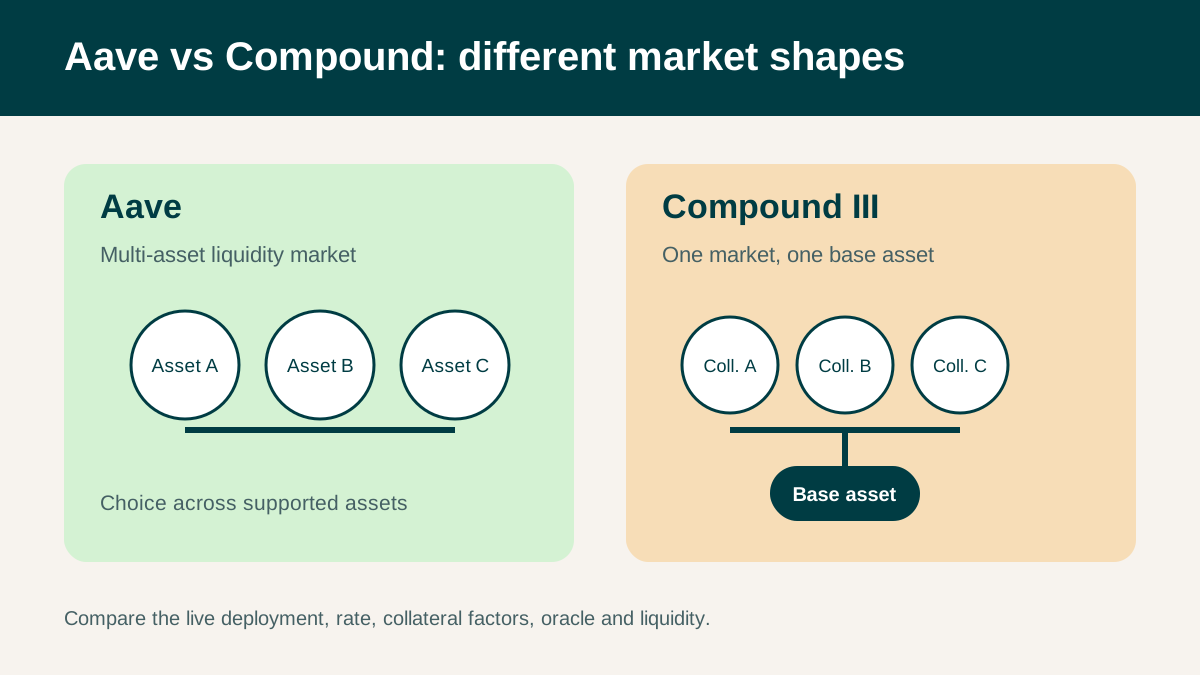
Aave vs Compound at a glance
| Category | Aave | Compound III |
|---|---|---|
| Core design | Overcollateralised liquidity markets | Separate markets centred on a base asset |
| Borrowed assets | Multiple supported assets per deployment | The chosen market's base asset |
| Rate | Dynamic, influenced by utilisation and governance parameters | Dynamic utilisation curve for the base asset |
| Position metric | LTV, liquidation threshold and health factor | Borrow collateral factor and liquidation collateral factor |
| Collateral yield | Supplied assets may earn according to market rules | Collateral supplied to Compound III does not earn interest |
| Networks | Many EVM and other supported deployments | Multiple EVM deployments and base-asset markets |
| Liquidation | Position can be liquidated below required health | Position can be absorbed when it fails liquidation collateral requirements |
Always verify the live market. The same protocol can expose different risks on different chains.
How Aave works
Aave users supply supported tokens and can enable eligible assets as collateral. Borrow capacity depends on the asset's LTV and the account's overall collateral position. The health factor reflects the buffer before liquidation.
Borrow rates change as market utilisation and governance parameters change. Aave also uses asset caps and modes that can restrict which assets may be borrowed against certain collateral.
Aave's strength is breadth: users can often choose among several assets and networks. That breadth adds decisions around chain, deployment, collateral mode and asset-specific parameters.
How Compound III works
Each Compound III market has a base asset. Users supply supported collateral and borrow that base asset. For example, a USDC market is built around supplying or borrowing USDC, with approved collateral assets contributing borrowing capacity.
Compound distinguishes a borrow collateral factor from a liquidation collateral factor. An account may be unable to borrow more before it becomes liquidatable. The base-asset rate changes with utilisation, and collateral supplied to the market does not earn interest.
Compound's strength is a focused market structure. Its limitation is that the desired loan asset and collateral must exist in the relevant deployment.
Aave vs Compound: the differences that matter
Market and asset choice
Aave generally offers a broader set of borrowable assets within a deployment. Compound III asks the user to choose a market for a specific base asset. If you know you want that base asset, Compound's structure may be easier to reason about. If you need more asset choice, Aave may fit better.
Interest rates
Both protocols use variable rates. Aave describes rates as dynamically determined by utilisation and governance parameters. Compound III uses separate supply and borrow curves with a kink after which the rate can rise more quickly.
Compare the live native borrow rate and do not let temporary rewards obscure the debt's underlying accrual.
Collateral efficiency
The maximum headline LTV is not a target. Asset factors, liquidation thresholds and price volatility determine how much practical buffer exists. A higher borrowing limit can mean less time to respond to a market move.
Liquidation
Both rely on onchain liquidation mechanisms rather than a negotiated grace period. A transaction can become eligible when the position crosses the applicable threshold. Your ability to react depends on wallet access, network conditions and available funds.
Security and governance
Aave and Compound publish code and governance activity. Aave also publishes a large security-review library. This evidence is useful, but no audit eliminates contract, oracle, governance, frontend, token or network risk.
Aave vs Compound for Bitcoin collateral
Neither protocol accepts native BTC on the Bitcoin network. Bitcoin exposure generally requires a token compatible with the chosen smart-contract chain. That can add an issuer or bridge, network, smart contract, oracle and market-liquidity dependency.
For someone who specifically wants to keep collateral as native BTC, a centralised Bitcoin-backed loan is a different route. Ledn typically lends at 50% initial LTV with a fixed 9.25%–11.49% APR based on loan size, a USD 500 minimum and a 12-month standard term. It requires identity and eligibility checks and involves custody under a loan agreement. The Ledn vs Aave comparison explores this trade-off directly.
The comparison is therefore not “DeFi good, CeFi bad” or the reverse. It is a choice between different trust and failure models.
Who may prefer Aave?
Aave may fit users who:
- want broader asset selection within a market
- want access across multiple supported networks
- understand health factor, asset modes and governance parameters
- find deep liquidity in their chosen pair
Who may prefer Compound?
Compound III may fit users who:
- want to borrow a market's defined base asset
- prefer a focused collateral-to-base-asset structure
- understand borrow and liquidation collateral factors
- find suitable liquidity and asset support in a specific deployment
Frequently asked questions
Is Aave better than Compound?
Not universally. Aave may offer broader asset choice, while Compound III may offer a simpler base-asset market for a particular use case. Compare the live deployment and position.
Which has lower borrowing rates?
The answer changes with utilisation, asset and network. Check both live markets immediately before borrowing and model a rate increase.
Can I use Bitcoin on Aave or Compound?
You generally use a tokenised representation of Bitcoin on the relevant network, not native BTC. Review the token issuer or bridge and potential tax treatment.
Can I lose collateral?
Yes. If the position becomes eligible, liquidators can repay debt and take collateral under protocol rules. Contract, oracle, token and network failures can create additional losses.
Do Aave and Compound require a credit check?
The protocols themselves use overcollateralisation rather than a traditional credit assessment. A frontend or access provider may apply its own terms or restrictions.
Editorial sources
Related Ledn guides: DeFi lending platforms, Aave alternatives, crypto lending platforms and Ledn security.
- Aave V3 introduction
- Aave borrowing guide
- Aave security
- Compound III documentation
- Compound collateral and borrowing
- Compound interest rates
- Ledn Bitcoin-backed loans
This article is general information only, not financial, investment, legal, accounting or tax advice. It does not recommend either protocol. Rates and parameters can change. DeFi borrowing can result in liquidation and partial or total loss.
The experts opinions:

CTA Block 1
Ledn was created by people who believe in Bitcoin’s power to revolutionise finance and build wealth reliably.
CTA ButtonCTA Block 2
Ledn was created by people who believe in Bitcoin’s power to revolutionise finance and build wealth reliably.
CTA ButtonCTA Block 3
Ledn was created by people who believe in Bitcoin’s power to revolutionise finance and build wealth reliably.
CTA ButtonCTA Block 4
Ledn was created by people who believe in Bitcoin’s power to revolutionise finance and build wealth reliably.
CTA Button