5 Aave Alternatives for Crypto Borrowing in 2026



Ledn has over $11 billion in loan originations since 2018 and counting!
Aave is one of the most established onchain lending protocols, with broad network coverage, dynamic rates and extensive public security documentation. An alternative may still be useful when you want isolated markets, a different chain, borrower-set rates—or a loan against native Bitcoin rather than a tokenised version.
This comparison starts with needs, not claims that a competitor has failed. Details were checked on 3 September 2026 and market parameters can change at any time.
Want to borrow against native BTC? Review Ledn Bitcoin-backed loans. Ledn is a centralised lender, not a DeFi protocol, and availability varies.
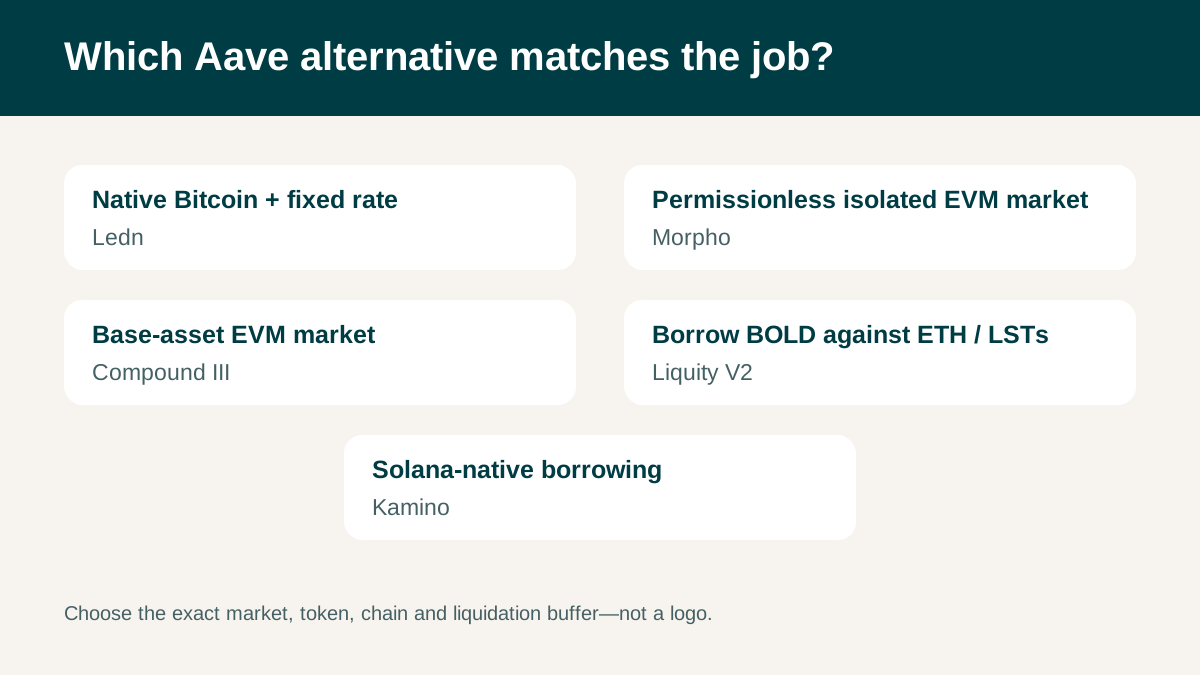
Aave alternatives compared
| Alternative | Type | Consider it when… | Key trade-off |
|---|---|---|---|
| Ledn | Centralised Bitcoin lender | You want native BTC collateral, a fixed rate and support | Requires identity/eligibility checks and custody |
| Morpho | DeFi, EVM | You want permissionless isolated markets | Market selection adds oracle, curator and liquidity analysis |
| Compound III | DeFi, EVM | You want base-asset markets with explicit factors | Assets and borrowing differ by deployment |
| Liquity V2 | DeFi, Ethereum | You want to borrow BOLD against ETH/LSTs and set a rate | Redemption and stablecoin mechanics require study |
| Kamino | DeFi, Solana | Your assets and activity are on Solana | Solana-specific market, oracle and network risks |
When Aave may still be the right choice
Aave lets users supply supported tokens and borrow from overcollateralised markets across multiple networks. Rates are dynamically determined, and users monitor LTV, liquidation threshold and health factor. Aave publishes extensive audits, formal verification work and governance processes.
It may remain a strong fit when the exact asset pair has deep liquidity, you understand its parameters and you prefer Aave's interface or governance model. No alternative should be chosen simply because its headline APY is temporarily lower.
1. Ledn: an alternative for native-Bitcoin borrowing
Ledn is structurally different from Aave. It accepts native BTC, provides a USD-denominated loan through a centralised service and uses a fixed rate based on each loan's size.
Current published terms include a USD 500 minimum, typical 50% initial LTV, 12-month standard term and 9.25%–11.49% APR. There are no required monthly payments before closure or early-repayment penalties. Identity, location and eligibility checks apply.
For Custodied Loans, collateral may only be re-posted to an institutional USD funding partner or Ledn-sponsored financing vehicle. Ledn says it remains in custody, ring-fenced or bankruptcy-remote as applicable, and cannot be lent out to generate interest by Ledn or the partner.
Ledn may fit a Bitcoin holder who wants to avoid tokenising BTC and prefers support and a contracting entity. Aave may fit someone who wants permissionless multi-asset borrowing and accepts onchain risks. See the full Ledn vs Aave comparison.
2. Morpho: isolated, permissionless markets
Morpho permits creation of ERC-20 lending markets defined by a loan asset, collateral asset, oracle, rate model and liquidation LTV. This allows granular market choice, but also means “using Morpho” is not enough information to assess a position.
Check who created or curates the market, the oracle, LLTV, liquidity and warnings. A position becomes liquidatable when LTV meets or exceeds LLTV, and a liquidator can seize collateral after repaying debt.
Morpho may fit users who prefer isolated markets and can evaluate each configuration. Aave may be easier for users who value larger pooled markets and its health-factor conventions.
3. Compound III: base-asset lending markets
Compound III enables supported collateral to back borrowing of a market's base asset. Rates are functions of base-asset utilisation, while collateral and liquidation factors are configured per asset and deployment.
Compound may fit users who want a base-asset-centred design. Aave generally presents broader pooled asset choice within each deployment. In both cases, review the exact contract, chain and parameters.
4. Liquity V2: user-set interest rates
Liquity V2 supports borrowing BOLD against ETH, wstETH and rETH. Borrowers choose and can adjust their interest rate. Its documentation lists a 2,000 BOLD minimum debt and no fixed repayment schedule while the position stays healthy.
The chosen rate interacts with protocol redemption mechanics, and Liquity relies on community or third-party frontends. It may suit Ethereum users who specifically want BOLD and understand those mechanics.
5. Kamino: a Solana-native alternative
Kamino provides borrow/lend markets on Solana, with reserves configured using LTVs, liquidation thresholds, rate curves and oracles. It may fit someone whose collateral and desired loan asset already live on Solana.
Moving assets solely to obtain a rate can add bridge and network risk. Compare the full route into and out of the position.
How to choose between Aave and an alternative
- Name the exact collateral token—not only the underlying asset.
- Name the chain and bridge, if any.
- Record current rate, rate model and incentives.
- Record LTV, liquidation threshold, penalty and oracle.
- Identify the contract, frontend and governance or administrative controls.
- Decide how you will top up or repay during congestion.
- Check tax consequences of wrapping, bridging, swapping and liquidation.
Frequently asked questions
What is the best alternative to Aave?
Morpho or Compound may suit EVM users, Liquity may fit ETH-backed BOLD borrowing, Kamino may fit Solana users, and Ledn may fit native-Bitcoin borrowers who prefer a centralised loan. The best match depends on the exact position.
Is Ledn a DeFi platform?
No. Ledn is a centralised Bitcoin-focused financial-services provider. It requires eligibility checks and takes custody under its loan agreement.
Is Morpho safer than Aave?
Neither can be labelled universally safer. Their market architectures, parameters, integrations and governance differ. Compare the exact market and your own operational risk.
Does Aave support native Bitcoin?
Aave operates on smart-contract networks, so Bitcoin exposure generally uses a tokenised form of BTC rather than native BTC on the Bitcoin network.
Why might I avoid the lowest DeFi rate?
It may sit in a thin, incentivised or unusually configured market. A low rate does not show oracle quality, liquidity, token risk or liquidation buffer.
Editorial sources
Related Ledn guides: DeFi lending platforms, Aave vs Compound, Bitcoin loan rates and Ledn security.
- Aave borrowing
- Aave security
- Morpho FAQ
- Morpho liquidation
- Compound III documentation
- Liquity V2 borrowing
- Kamino documentation
- Ledn Bitcoin-backed loans
This article is general information only, not financial, investment, legal, accounting or tax advice. It does not recommend a protocol or lender. Rates and parameters change. Digital-asset borrowing can result in liquidation and partial or total loss.
The experts opinions:

CTA Block 1
Ledn was created by people who believe in Bitcoin’s power to revolutionise finance and build wealth reliably.
CTA ButtonCTA Block 2
Ledn was created by people who believe in Bitcoin’s power to revolutionise finance and build wealth reliably.
CTA ButtonCTA Block 3
Ledn was created by people who believe in Bitcoin’s power to revolutionise finance and build wealth reliably.
CTA ButtonCTA Block 4
Ledn was created by people who believe in Bitcoin’s power to revolutionise finance and build wealth reliably.
CTA Button