Managing a Bitcoin-Backed Loan: LTV, Repayment and Renewal


Ledn has over $11 billion in loan originations since 2018 and counting!
Manage your Bitcoin-backed loan before volatility forces a decision.
Check Ledn’s current loan terms and risk thresholds →
Bitcoin's price can move fast -- and if you have a bitcoin-backed loan, those moves directly affect your loan-to-value (LTV) ratio.
A funded reserve, clear response plan and timely monitoring can reduce avoidable risk. They cannot guarantee that collateral survives every market move. This guide explains LTV, Auto Top-Up, partial repayment, transfer timing, redemption and maturity using concrete examples.
1. Understand Your LTV — and Why It Matters
Your loan-to-value (LTV) ratio is the relationship between what you owe and the value of the bitcoin collateral securing your loan:
LTV = Loan Balance ÷ Collateral Value
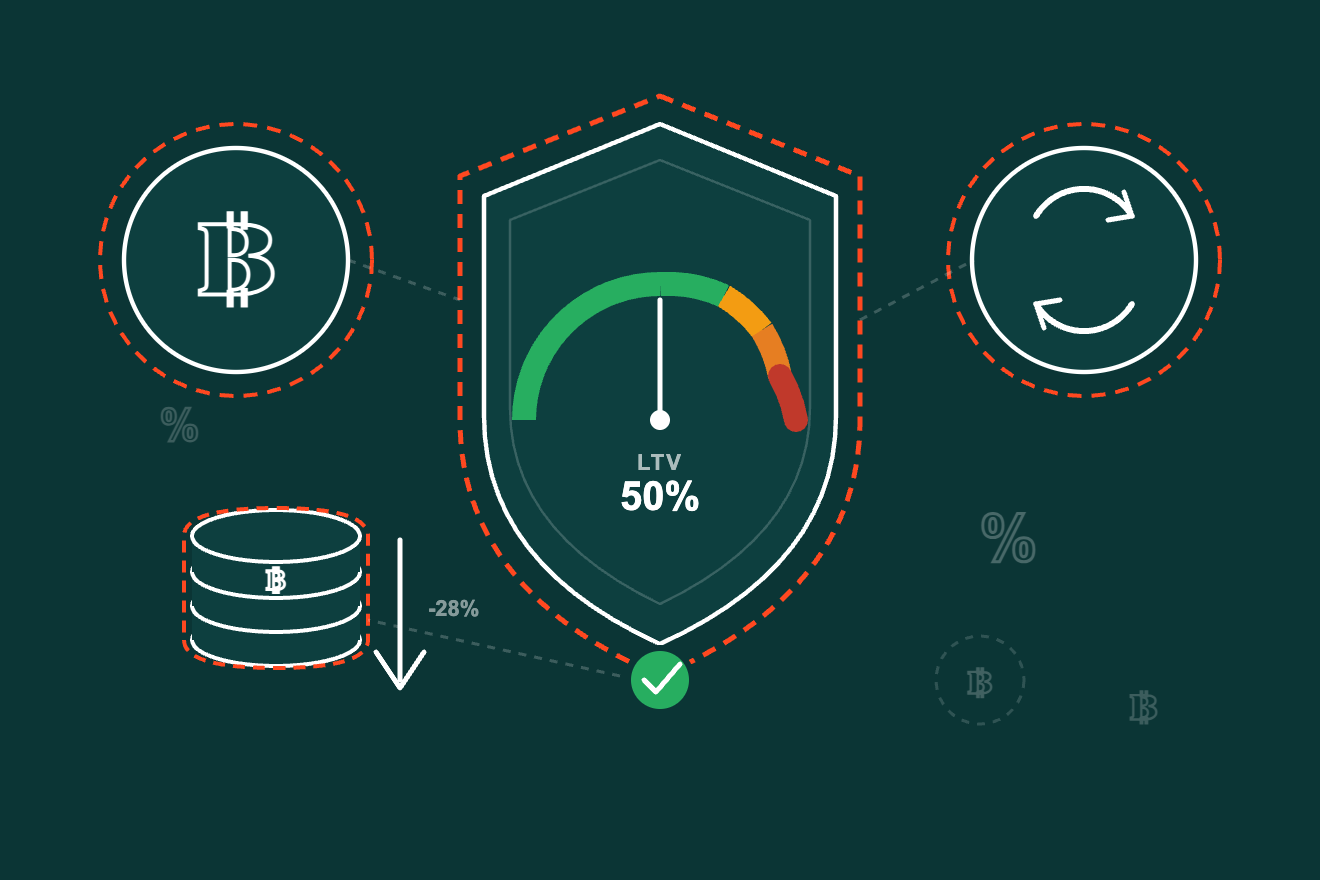
Example: You borrow $30,000 and pledge 1 BTC worth $60,000. Your LTV is 50%.
When bitcoin's price falls, the value of your collateral falls — which pushes your LTV higher. If it rises above Ledn's maintenance threshold, Ledn will ask you to top up your collateral or repay part of the loan to bring the ratio back down.
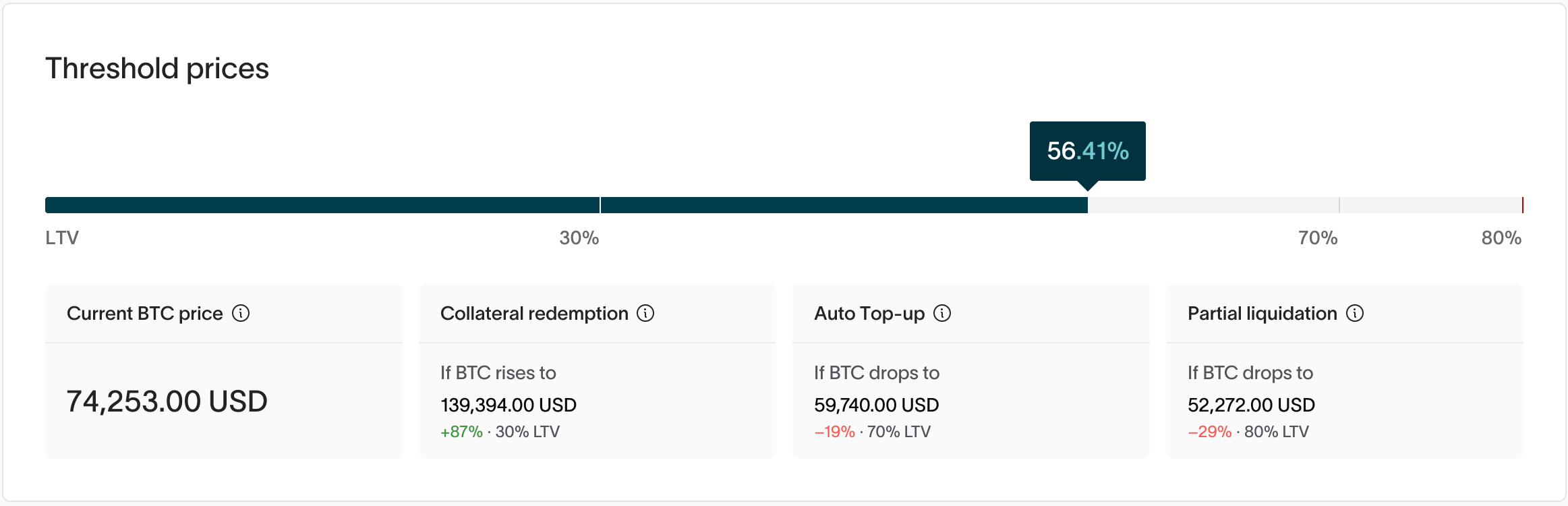
Key LTV thresholds to know
| LTV Level | Status | What it means |
|---|---|---|
| Below 60% | Healthy | Continue monitoring and maintain your plan |
| 60–70% | Approaching threshold | Good time to act proactively |
| 70% / 75% | At risk | Ledn will notify you to top up |
| 80% or above | Automatic liquidation | Automatic liquidation settles the loan |
Ledn's published Bitcoin-loan process includes notifications at 70% and 75%, with automatic liquidation at 80%. The lower bands are monitoring examples, not promises that a position is safe.
2. Enable and fund Auto Top-Up
Make a deliberate choice about your automated collateral reserve:
Turn on Auto Top-Up in your Ledn account.
When enabled and funded, Auto Top-Up uses BTC from your Transaction Account when LTV reaches 70%, targeting 68%. If the balance is insufficient, the available BTC may be added without reaching the target. It does not empty an adequately funded reserve automatically.
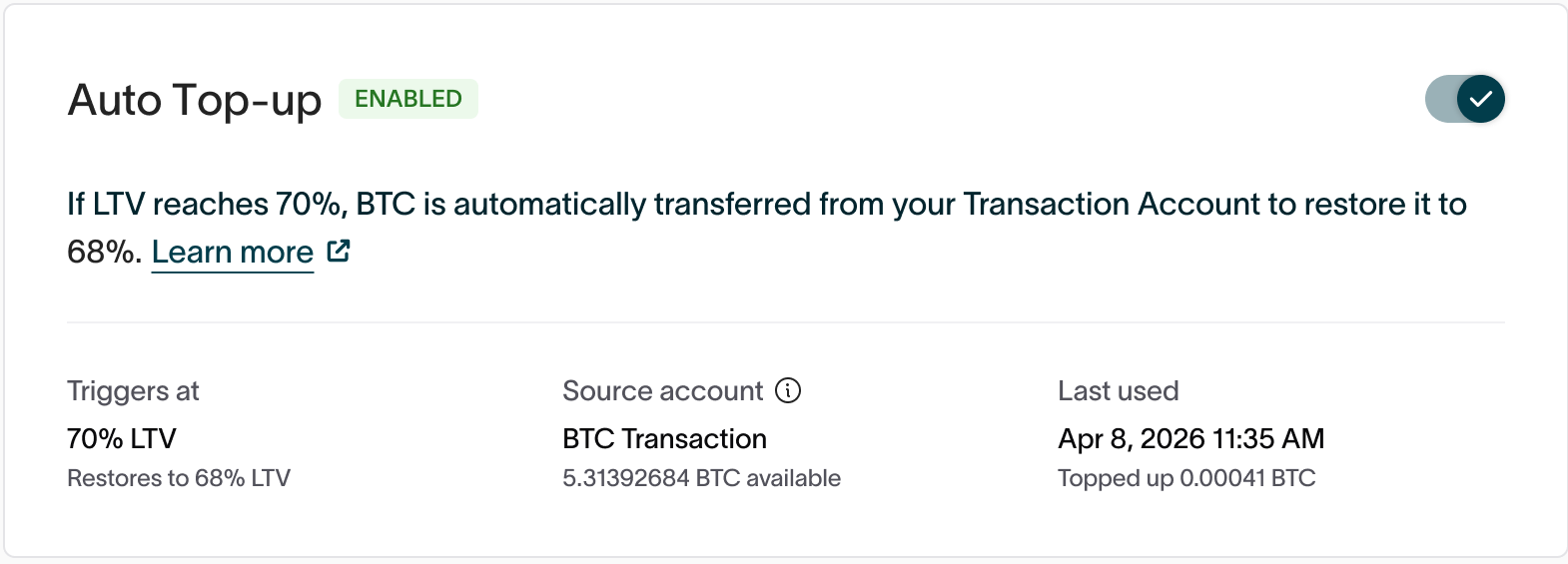
How to turn on Auto Top-Up
- Log in to your Ledn account at ledn.io
- Navigate to your loan dashboard
- Find the Auto Top-Up toggle and switch it on
- Confirm the action when prompted
Check both the portfolio setting and the individual loan's setting, then confirm sufficient BTC is available. Continue monitoring: turning on a switch is not the same as funding it.
What Auto Top-Up needs to work
Auto Top-Up draws from your Ledn Transaction Account. For it to fire successfully, you need to keep a BTC reserve there. Think of it as a buffer — extra collateral sitting ready in the background.
Size your reserve by stress-testing the loan, not by treating one percentage as universally sufficient. Extra BTC creates a buffer, but its dollar value also falls when BTC falls. Consider both top-up capacity and access to other repayment funds.
Illustration: 0.10–0.20 BTC held against a 1 BTC collateral position provides additional BTC capacity, but it is not a recommended minimum or guaranteed protection. Calculate the result at lower prices and after accrued charges.
3. How to Monitor Your LTV
Even with Auto Top-Up enabled, it's worth keeping an eye on your position — especially during periods of sustained price decline.
Where to check
- Log in to your Ledn account and go to your loan dashboard
- Your current LTV is displayed prominently
- You'll also receive email notifications as your LTV approaches key thresholds
What to watch for
| Signal | Recommended action |
|---|---|
| BTC drops 10–15% in a day | Check your LTV. Confirm your Transaction Account has a healthy BTC reserve. |
| You receive a Ledn LTV warning email | Log in immediately and verify Auto Top-Up is on and funded. |
| BTC enters a multi-week downtrend | Consider proactively adding more BTC to your Transaction Account or making a partial USDC repayment (see Section 5). |
| Network congestion warnings in the news | Act immediately — don't wait. Transfer and confirmation times can lengthen when the network is busy (see Section 6). |
4. Real-World Scenarios: What Happens When BTC Drops
The following examples use round numbers to illustrate how your LTV moves with bitcoin's price, and at what point action is needed.
Starting position
Loan balance: $30,000
Collateral: 1 BTC
BTC price at loan start: $60,000
Starting LTV: $30,000 ÷ $60,000 = 50%. This is a starting buffer, not a guarantee of safety.
Scenario table
| BTC price | Collateral value | LTV | Status / Action |
|---|---|---|---|
| $60,000 | $60,000 | 50% | 50% initial LTV; continue monitoring |
| $50,000 | $50,000 | 60% | ⚠ Watch — consider adding reserve |
| $42,857.14 | $42,857.14 | 70% | 🚨 At Risk — Auto Top-Up fires |
| $38,000 | $38,000 | 79% | 🔴 Urgent — top up immediately |
| $37,500 or below | $37,500 or below | 80%+ | Automatic liquidation |
What Auto Top-Up does in this scenario
With a fixed $30,000 balance and 1 BTC pledged, 70% LTV occurs at a BTC price of approximately $42,857.14. To reach 68% at that same price, collateral must be worth $44,117.65, or about 1.02941 BTC. Auto Top-Up therefore needs about 0.02941 BTC, not the entire 0.20 BTC reserve.
Illustrative transfer: 1.02941 BTC × $42,857.14 ≈ $44,117.65 of collateral, leaving about 0.17059 BTC from a 0.20 BTC reserve.
Resulting LTV: $30,000 ÷ $44,117.65 = 68%. This excludes interest, fees and further price movement. A continued decline can require another action and can still reach liquidation.
Choose the resource you want to commit
With a hypothetical $50,000 debt and $80,000 of BTC collateral, LTV is 62.5%. Repaying $10,000 reduces debt to $40,000 and LTV to 50%. Adding $20,000 of BTC instead leaves debt at $50,000 against $100,000 of collateral, also 50% LTV. The ratio matches, but repayment reduces the balance on which interest accrues; a top-up commits more BTC while retaining the debt.
Choose based on available cash, unpledged BTC and the repayment plan—not only the resulting ratio. Review the balance, LTV and available reserve after every change. If someone helps manage the loan, establish authorised responsibilities through the provider’s supported process; do not share account credentials.
5. Compare a partial repayment with adding collateral
A repayment from outside funds lowers debt; adding BTC increases collateral without reducing debt. Supported repayment routes may include stablecoins, bank payment or BTC collateral. A BTC-collateral repayment changes both sides of the ratio, so inspect its projected effect before authorising it.
How it works
- Log in to Ledn and navigate to your loan
- Choose an available repayment method in your account and review the confirmation, including any charges and the projected LTV.
- You do not need to repay the full loan — even a partial repayment reduces your LTV
- Confirm the payment has settled and been applied. External bank or blockchain transfers can require processing time; initiating a transfer is not the same as reducing the loan balance.
When to use partial repayment
Partial repayment is a good option if:
- You have USDC available and don't want to use BTC to reduce your LTV
- You want to reduce your loan balance permanently (rather than just adding more collateral)
- Auto Top-Up has fired and you want to rebuild your BTC reserve before the next dip
Illustration: if the outstanding balance is $30,000 at 68% LTV, collateral is worth about $44,117.65. An applied $3,000 payment from outside funds reduces the balance to $27,000 and LTV to 61.2%, assuming no other changes. Charges and allocation rules affect the principal reduction; use the platform's projected and final values.
6. Act Early: The Bitcoin Network Timing Problem
⚠️ Critical: don't wait until everyone else is acting.
Network congestion, transfer fees and confirmation requirements can delay an external BTC deposit. A falling market can leave less time to complete a transfer than expected. Do not rely on a fixed two- or three-hour estimate as a maximum.
If your margin call is urgent and your transaction is stuck in the mempool, your collateral may be liquidated before the transfer confirms.
How to avoid this problem
- Consider enabling funded Auto Top-Up before a price decline. Its 70% trigger coincides with the first notification level; it does not run before every risk warning or guarantee protection.
- A BTC reserve already in the Transaction Account avoids starting a fresh external deposit when a top-up is needed. It still depends on available funds, correct settings and system execution.
- If sending BTC from an external wallet, act well in advance. Monitor your LTV and move BTC before you're in the margin call zone, not during it.
- Plan a supported repayment route as another option. A stablecoin transfer has its own network and processing requirements; it is not guaranteed to arrive faster in every case.
The key advantage of keeping BTC inside Ledn
A pre-funded Transaction Account lets Auto Top-Up draw on an existing balance, reducing dependence on an emergency external BTC transfer. Keep enough liquidity for your wider needs and verify the actual top-up in the account; do not assume that an enabled feature removes monitoring or execution risk.
7. What Happens When Bitcoin's Price Recovers?
If bitcoin's price rises significantly after you've topped up your collateral, your LTV will fall — potentially well below your original level. When that happens, Ledn's Excess Collateral Redemption feature lets you unlock a portion of that extra collateral and put it back to work.
What is Excess Collateral Redemption?
If your LTV drops below 30%, you can request to redeem part of your collateral. Ledn will release enough BTC to bring your LTV back up to 40%, transferring it directly to your Transaction Account.
Example: Your loan balance is $30,000. BTC has recovered and your collateral is now worth $120,000, giving you an LTV of 25%. You can redeem BTC until your LTV returns to 40% — in this case, releasing $45,000 worth of BTC (bringing collateral value to $75,000).
Eligibility requirements
These are the current collateral-redemption conditions.
You can redeem excess collateral if all of the following apply:
- Your loan has been active for more than 60 days
- Your current LTV is below 30%
- You have not redeemed collateral in the last 60 days
- Your loan is not within 30 days of its maturity date
- You have at least $100 USD worth of redeemable collateral (maximum $100,000 USD every 60 days)
How to redeem
- Go to the Active Loans tab in your Ledn Dashboard
- If your loan is eligible, you will see a "Redeem Collateral" button
- Click it to unlock the available amount
- The BTC will be transferred to your Transaction Account
Released BTC moves to the Transaction Account. You can retain it as a reserve or use supported transfer and trading functions. Do not assume that the Transaction Account pays interest or that another product is available in your region.
Important note:
Collateral redemption does not refinance your loan or increase your loan amount — it simply releases bitcoin that is in excess of what is needed to secure your current loan balance.
Plan for maturity as well as a price decline
The standard loan term is 12 months. From 1 January 2027, accrued interest and fees must be paid in full at maturity or mid-term refinancing. Eligible principal can roll into a new term at the then-current rate if jurisdiction and product conditions are met and LTV is below 65%. Refinancing before maturity also requires a loan age of at least 30 days.
At maturity, available stablecoins can cover accrued fees. If they are insufficient, the automatic backstop sells the minimum BTC needed for the shortfall and, where necessary, to bring LTV to 64%. This reduces BTC holdings and may have tax consequences. If renewal is unavailable and the loan remains unpaid, liquidation occurs at 11:59 PM system time on maturity day, with no grace period. Allow up to five business days for a bank wire; do not leave settlement to the final day.
8. Your management checklist
Do this now, before volatility hits:
☐ Log in to Ledn and enable Auto Top-Up
☐ Check your available reserve against a lower-price scenario and your repayment needs.
☐ Note your current LTV and the margin call threshold for your loan
☐ Save Ledn support contact details in case you need to act quickly
☐ If BTC drops sharply, check your LTV before the mempool gets congested
Questions? Contact Ledn support via your account dashboard.
This guide is general information, not personalised financial, tax or legal advice. The numerical scenarios exclude charges and price changes unless stated. Review your agreement and Ledn’s Risk Disclosure Statement.
The experts opinions:

CTA Block 1
Ledn was created by people who believe in Bitcoin’s power to revolutionise finance and build wealth reliably.
CTA ButtonCTA Block 2
Ledn was created by people who believe in Bitcoin’s power to revolutionise finance and build wealth reliably.
CTA ButtonCTA Block 3
Ledn was created by people who believe in Bitcoin’s power to revolutionise finance and build wealth reliably.
CTA ButtonCTA Block 4
Ledn was created by people who believe in Bitcoin’s power to revolutionise finance and build wealth reliably.
CTA Button