Bitcoin-Backed Loan Providers for High-Net-Worth Individuals

A Ledn tem mais de 9 bilhões de dólares em originações de empréstimos desde 2018 e contando!
Bitcoin-backed loans have become a tool that some high-net-worth individuals (HNWIs) incorporate into their financial planning. These instruments can provide access to fiat liquidity, which some borrowers find useful for their financial planning. Let’s explore what makes them appealing to some users.
The following providers were selected based on their prominence in the Bitcoin-backed lending market as of 2026. This comparison draws on publicly available information, including each provider's published documentation, public statements, and regulatory history. The selection is not exhaustive and does not represent a ranking.Looking to unlock liquidity against your bitcoin? Open an account with Ledn today.
Why Seek a Bitcoin-Backed Loan?
Bitcoin-backed loans benefit a wide range of users, but for HNWIs, they serve several specific purposes.
Access to a 24/7 Market
Unlike conventional equities and FX markets that are restricted by a rigid 9-to-5 schedule, Bitcoin trades 24/7. Because Bitcoin's most significant volatility often occurs over the weekend, having the ability to secure loans or adjust collateral at any hour may allow borrowers to respond to market movements without waiting for standard banking hours.
Securing Fiat Without a Credit Check
Some Bitcoin-backed loan providers do not require a credit check, which can simplify the application process. For some HNWIs, this is especially meaningful, as their credit scores may inaccurately reflect their financial capabilities. Such discrepancies can arise when a significant portion of an individual's wealth is held in assets like Bitcoin, which traditional credit scoring models may not fully account for.
Diversification
Some borrowers use Bitcoin-backed loans as a way to hold assets across different types of institutions, rather than concentrating entirely within traditional banks or brokerages. By using a Bitcoin-backed lending service, a borrower's collateral is held by a different type of custodian than their traditional financial providers, which some view as a form of institutional diversification.
Liquidity and Capital Mobility
In times of global economic distress, such as recessions or volatility caused by geopolitical affairs, moving and securing fiat can be too sluggish a process, especially when users are working with large quantities. Traditional financial solutions lack the speed many HNWIs require. Some borrowers value the ability to access liquidity without liquidating their BTC position, which can provide flexibility in situations where traditional banking may be slower to respond.
For instance, in situations where access to traditional banking is disrupted, some individuals may find that Bitcoin-based financial services offer an alternative means of accessing liquidity. Eligible clients of services like Ledn may receive funding in as little as six hours, subject to verification and product availability.
Risk Management and Awareness for Bitcoin-Backed Loans
There are specific risks to consider regarding Bitcoin-backed loans for high-net-worth individuals.
Liquidation Risk
Bitcoin price can be volatile. If the price of BTC decreases, it can spike the loan-to-value (LTV) ratio, meaning a user's outstanding balance would represent a higher percentage of their collateral's total value. As a result, borrowers may need to deposit additional collateral to keep the loan secured.
If the LTV crosses a certain threshold, which for platforms like Ledn is 80%, the lender will liquidate a portion of the BTC used as collateral. In cases of significant price drops, this can even lead to the entire position being liquidated. Some borrowers choose to maintain a lower LTV, such as 50%, to create a cushion against volatility. Liquidation offers little benefit to any party, including the lender; therefore, understanding this risk is crucial.
Platform Insolvency Risk
When working with centralized custodians, there is always the risk that the platform will become insolvent and unable to operate normally. If a platform legally separates client collateral from its own operational finances, insolvency may not necessarily result in the loss of client collateral, though borrowers should review the specific legal protections in place. However, even in these cases, insolvency must still be considered. If users are still seeking Bitcoin-backed loans, they would need to reassess their financial strategies, find an alternative platform, and conduct additional research.
DeFi Malfunction Risk
DeFi services carry a risk of coding malfunctions or attacks that could render the network inert or leave it no longer functioning as intended. Because these systems are highly automated and use smart contracts to secure loans, they introduce vulnerabilities surrounding the health of the network itself.
DeFi protocols do not operate with BTC directly, as the asset is highly incompatible with practically every other blockchain ecosystem. Instead, they use wrapped BTC - assets that represent the price of BTC but have been designed to function within networks like Ethereum or Solana. If the smart contracts or the architecture used to hold collateral and provide other assets in return break, or if a vulnerability is discovered, the protocol may cease to function properly, theoretically leading to the loss of user funds. An important example of this is the Balancer V2 exploit, in which a DeFi protocol was drained of $128 million worth of assets due to hackers exploiting a vulnerability.
Four Bitcoin-Backed Loan Providers for High-Net-Worth Individuals
1. Ledn
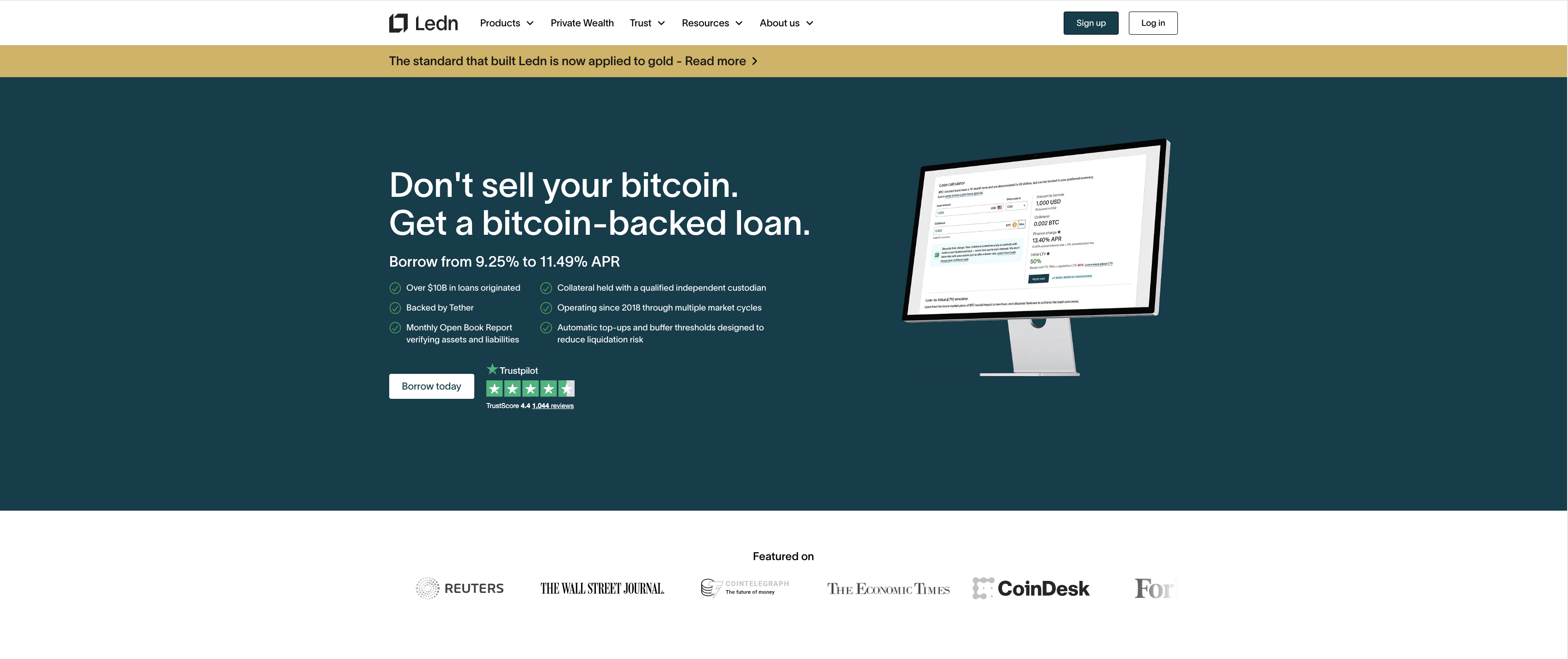
Ledn positions itself as a provider for HNWIs seeking Bitcoin-backed loans due to its security, liquidation defenses, and transparency.
Security with Ledn
Ledn states that it uses custody controls designed to protect client collateral. With its custodied loans, the borrower’s BTC is held in a 1:1 state and legally ring-fenced from institutional funding partners. The company also never lends out or rehypothecates collateral to generate interest. To reinforce its security, Ledn has funded more than $10 billion in Bitcoin-backed loans, and as of July 2026, Ledn reports no client collateral losses attributable to its custody model. Of course, past performance does not guarantee future outcomes.
Liquidation Defense
A key concern for HNWIs is that their collateralized BTC will be liquidated in the event of sharp price drops. While this is always a possibility and a risk that can never be entirely mitigated, Ledn implements tools to help alleviate the situation. Users are alerted if their LTV rises beyond a certain threshold, keeping clients aware of their circumstances. Additionally, Ledn provides an auto-top-up tool that can automatically transfer assets from a user's transaction account to their loan collateral address to prevent full liquidation.
No Native Token
Ledn does not issue or require a native platform token. Some platforms tie their most competitive rates to holdings of a proprietary token, which introduces an additional asset for users to evaluate and manage. Ledn's model avoids this, meaning borrowers interact only with BTC and fiat.
Platform Transparency
Ledn publishes monthly open-book reports and biannual proof-of-reserve attestations. This allows users to review the company's reported financial position and examine details of its operations. Alongside this, the platform is audited by The Network Firm LLP. In an industry where both CeFi and DeFi lending services have experienced insolvency events, this level of reporting can help clients evaluate a provider's financial standing.
Tiered Pricing
Ledn offers tiered interest rates which decrease for larger loan amounts. As of 2026, loans over $2 million are listed at 9.25% APR. Rate availability may vary and is subject to change. This requires no negotiations or additional steps.
Want to unlock liquidity against your bitcoin? Open an account with Ledn today.
2. Nexo
Nexo is known for its competitive rates on Bitcoin-backed loans. To access its most enticing rates, users must hold a certain quantity of its native token, which it ties to the best deals in its ecosystem. Since recently re-entering the US market, Nexo has attracted some HNWIs. However, there are security questions as the service lacks in-depth proof-of-reserve reporting and has faced regulatory challenges in the past. These resulted in a $45 million settlement with the SEC and a five-year ban from participating in the securities industry in New York.
3. Morpho
Morpho is a DeFi lending protocol known for its approach to innovation. In April 2026, the platform announced an integration with AI agents to operate within its network. For HNWIs who wish to keep ahead of the technological curve, Morpho can seem appealing. It has also been integrated with Coinbase since January 2025.
Despite being a DeFi service, on the surface it appears to work directly with BTC. However, in reality, the protocol explains that users can hold BTC via the Coinbase app, with Coinbase providing its BTC wrapper (cbBTC) as collateral to Morpho. This means the loans are not actually secured in Bitcoin and require another asset to operate. Additionally, because this is a DeFi protocol, there is no release of fiat; rather, it allows users to borrow USDC. Networks like Morpho are optimized for permissionless, cutting-edge activity, but as a trade-off, there is a learning curve and additional steps compared to a CeFi service.
4. Strike
Strike is a CeFi service focused specifically on BTC. The platform has attracted attention for its focus on simplicity and a Bitcoin-only approach. Not only does it offer lending solutions, but also Bitcoin lines of credit, providing more flexibility. However, Strike does not reveal proof-of-reserve auditing information or attestations. A representative for Strike stated that the majority of its customer base does not keep BTC on the platform, so audits and attestations like this would be highly complex to implement and may not provide a meaningful reflection of its reality. In particular, the representative was referring to customers who use its services to buy Bitcoin, not customers who seek lending solutions. This means certain aspects of its operational and reserve structure are not publicly auditable in the same way as platforms that publish proof-of-reserve reports.
What to Look Out For in a Bitcoin-Backed Loan
HNWIs should consider a range of features when choosing the ideal Bitcoin-backed loan.
Transparency
Whether using a CeFi service or a DeFi protocol, transparency is paramount. Users should have access to clear knowledge about an organization’s financial health so they can make an informed decision. Such insight is especially important when moving and securing significant quantities of wealth.
Audits and Attestations
HNWIs may wish to seek out audits and attestations for their chosen services. These provide a granular view of a company’s economic standing, offering assurance on whether it is suitably fit and able to engage in its operations. While all Bitcoin borrowers can benefit from this data, it is especially important for HNWIs because they need to be certain that the organizations have the capability to manage their significant wealth.
Ring-Fencing and Rehypothecation
Clients may want to know whether the service they work with is legally ring-fencing their assets from the general financial activity of the company. This means that collateral is separated and treated distinctly, rather than all funds being mixed within the organization. Relatedly, users will want to know whether the platform performs rehypothecation - the process of lending their assets to other users, including institutional funding partners, or using it in yield-generating DeFi strategies. This practice is a consideration for clients, as it means their collateral may be used for purposes beyond securing their own loan.
Customer Support
Some borrowers value having access to hands-on customer support, particularly when managing significant loan positions. If users know there is somebody they can reach out to should issues arise, it can provide a more reassuring experience. This is why many HNWIs choose CeFi services over DeFi, as distributed protocols are designed to function without such intimate customer support. Additionally, because actions are handled by automated smart contracts, the ability of customer service to intervene is inherently limited.
Bitcoin-Backed Loan Use Cases for High-Net-Worth Individuals
HNWIs leverage BTC-backed loans for a variety of purposes.
Securing Real Estate
Some borrowers have used Bitcoin-backed loans to help fund mortgage down payments. As the conventional financial sector is still slow to accept BTC as a marker of wealth, these individuals turn to loans to access fiat without needing to sell their positions. Some lenders, such as Ledn, do not require monthly repayments, allowing clients to fund a down payment without draining their monthly cash flow.
Diversification
Bitcoin-backed loans can be used as a means of diversifying a user’s portfolio. Some investors view Bitcoin-backed loans as a way to distribute their financial exposure across different types of institutions and systems, rather than focusing solely on asset-class diversification. Investors with significant capital may find that concentrating assets within a single type of financial institution creates a form of systemic concentration risk.
Some clients may view Bitcoin-backed loans as a way to distribute their financial exposure across different systems and jurisdictions, rather than concentrating entirely within traditional banking infrastructure. For instance, by using a Bitcoin-backed lending service, a borrower's collateral is held in a different type of custodial arrangement than their traditional banking or brokerage accounts, which introduces a distinct risk profile.
Plus, the wealth held in BTC is running on a decentralized blockchain that does not belong to any government or country, and which has been known to act asynchronously to standard markets in the past. Because positions are not sold, this independence remains meaningful for some users. The result is a portfolio that is not dependent on traditional banking infrastructure.
Business Funding and Operations
Engaging in business-related activities when BTC is a user's primary asset can be complex. Many institutions and potential partners will not view it with the same respect as they do fiat. While fiat serves many purposes, some individuals prefer not to sell their BTC holdings. By accessing a loan, they can keep their Bitcoin while using it as collateral to obtain legal tender, which some find useful for business-related transactions.
Conclusion
Bitcoin-backed loans are one financing option available to high-net-worth individuals. As with any financial product, their suitability depends on the borrower's individual circumstances, including their risk tolerance, liquidity needs, and broader financial objectives. Prospective borrowers should carefully evaluate the risks discussed in this article. This includes collateral liquidation, platform risk, and market volatility, alongside the potential benefits before making a decision.
Bitcoin-backed loans are not suitable for every investor. Borrowers should carefully consider market volatility, collateral liquidation risk, tax implications, and their financial circumstances before borrowing.
Disclaimer
This article is sponsored by 21 Technologies Inc. and/or its subsidiaries (“Ledn”) and is for general information, discussion, or educational purposes only and is not to be construed or relied upon as constituting legal, financial, investment, accounting, tax, estate-planning, or other professional advice or recommendation. Please read Ledn's full Risk Disclosure Statement and Disclaimers.
The experts opinions:

CTA Block 1
Ledn was created by people who believe in Bitcoin’s power to revolutionise finance and build wealth reliably.
CTA ButtonCTA Block 2
Ledn was created by people who believe in Bitcoin’s power to revolutionise finance and build wealth reliably.
CTA ButtonCTA Block 3
Ledn was created by people who believe in Bitcoin’s power to revolutionise finance and build wealth reliably.
CTA ButtonCTA Block 4
Ledn was created by people who believe in Bitcoin’s power to revolutionise finance and build wealth reliably.
CTA Button